


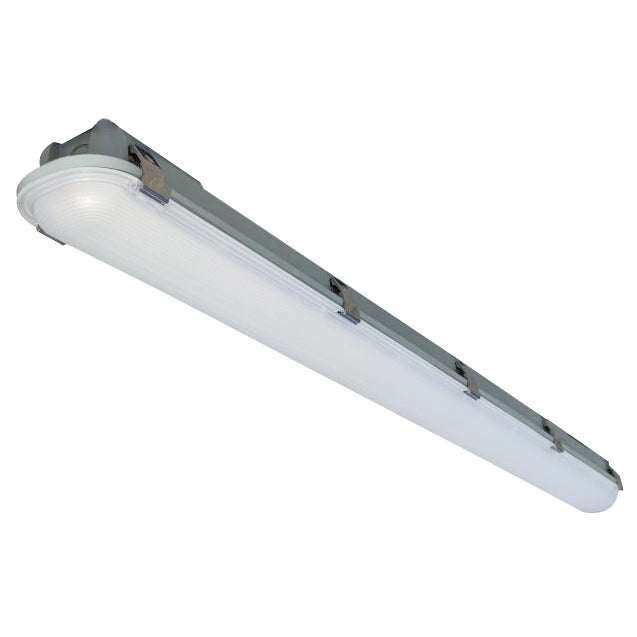





Certified Hazardous Location & Explosion-Proof LED Lighting
Heavy-duty, spark-free LED fixtures engineered for Class I, II, & III hazardous environments. Protect your workforce, eliminate costly downtime, and comply with strict NFPA and OSHA safety codes.
Why Hazardous Location Fixtures Require Specialized Engineering
In facilities where flammable gases, combustible dusts, or ignitable fibers are present, a conventional commercial light fixture can trigger catastrophic combustion. A simple loose bulb filament, an electrical arc, or excessive enclosure surface heat is enough to ignite the atmosphere.
Hazardous location LED lighting (commonly referred to as explosion-proof lighting) utilizes heavy-duty, copper-free cast aluminum enclosures, flame paths, and shock-resistant tempered glass lenses. These fixtures are engineered either to completely contain an internal explosion without igniting the surrounding environment (Class I, Division 1) or to eliminate any potential ignition source under normal operation (Class I, Division 2).
Critical Safety Factors
Before ordering hazardous fixtures, verify the following facility specs with your safety inspector or engineer:
- Class & Division: C1D1, C1D2, C2D1, or C2D2
- Gas / Dust Group: Groups A, B, C, D, E, F, or G
- Temperature Code (T-Rating): T1 through T6
- Mounting Method: Pendant, Ceiling, Wall Yoke, or Stanchion
Shop Hazardous Location Fixtures by Application
Explore our certified explosion-proof luminaires designed for oil & gas, paint spray booths, milling, and chemical processing.
Explosion-Proof Linear Fixtures
Direct replacement for fluorescent vapor-tights in paint spray booths, inspection lines, and processing corridors. Available in emergency battery backup configurations.
Hazardous Round High Bays & Low Bays
Engineered for high ceilings in chemical plants, oil refineries, and offshore drilling platforms. Replaces 400W–1000W metal halide fixtures with 140+ lm/W efficiency.
Hazardous LED Floodlights
Heavy-duty floodlights with adjustable trunnion and yoke mounts for fuel transfer docks, marine terminals, outdoor storage tanks, and perimeter security.
Explosion-Proof Emergency & Exit Lights
Code-mandated emergency egress lighting for hazardous zones. Includes integrated 90-minute Ni-Cad battery backups, self-diagnostics, and dual remote head capability.
Jelly Jars & Hazardous Wall Packs
Compact explosion-proof luminaires for stairwells, catwalks, pump rooms, utility tunnels, and tight machinery spaces where large high bays cannot fit.
Hazardous Mounting Hardware & Accessories
Heavy-duty mounting hardware including 25° stanchion mounts, pendant drop conduits, swivel yokes, wall brackets, safety cables, and wire guards.
Understanding Hazardous Location Classifications (NEC Article 500)
The National Electrical Code (NEC) classifies hazardous areas based on the type of ignitable hazard and the probability of its presence.
Flammable Gases, Vapors, & Liquids
Areas where flammable gases or liquids are produced, processed, or stored in quantities sufficient to produce explosive mixtures.
Combustible Dust Environments
Locations made hazardous by the presence of combustible or electrically conductive dusts that can cause flash fires or explosions.
Ignitable Fibers & Flyings
Facilities handling easily ignitable fibers or flyings that are not likely to be in suspension in air, but can rapidly burn if ignited.
Engineering Advantages of Upgrading to Industrial LED
Why modern plants are replacing high-pressure sodium and metal halide lamps with solid-state LED systems.
70% Energy Reduction
A 150W hazardous LED high bay replaces a 400W metal halide fixture while producing more uniform foot-candles, cutting power consumption dramatically across 24/7 facilities.
Instant-On & Zero Restrike Time
Unlike metal halide lamps that require a 10–15 minute cooling and restrike period after a brief voltage dip, LEDs restart immediately at 100% full brightness, maintaining crucial safety illumination.
Eliminates Hazardous Re-Lamping
Changing ballasts and bulbs in classified areas requires hot-work permits, equipment shutdowns, and costly scissor lifts. LEDs last 100,000+ hours, eliminating recurring maintenance risks.
Shock & Vibration Resistance
Solid-state LEDs have no fragile glass envelopes or filaments. Solidly mounted inside shock-tested copper-free cast aluminum bodies, they withstand continuous industrial vibration.
Industries & Classified Environments We Serve
Dependable illumination certified for mission-critical industrial, marine, and energy operations.
Oil & Gas Refineries
Offshore drilling rigs, processing units, pipelines, and storage terminals (Class I, Div 1 & 2).
Chemical & Petrochem
Solvent extraction rooms, chemical reaction vessels, and volatile containment areas.
Paint Spray Booths
Automotive spray rooms, industrial coating booths, and powder coat baking tunnels.
Grain & Agriculture Silos
Grain elevators, flour processing mills, sugar refineries, and animal feed manufacturing.
Wastewater Treatment
Digester buildings, grit chambers, sludge dewatering rooms, and methane extraction sites.
Marine & Port Terminals
Bunkering piers, ship fuel loading docks, coastal transfer yards, and hazardous cargo holds.
Pharmaceutical & Cleanrooms
Sterile cleanrooms using alcohol wipe-downs, solvent crystallization, and active synthesis.
Power Plants & Mining
Coal handling bunkers, turbine halls, conveyor galleries, and underground mining facilities.
Hazardous Location Lighting FAQs
Answers to common code, installation, and certification questions.
In Class I, Division 1, explosive gases, vapors, or liquids are present under normal, day-to-day operating conditions (such as inside a paint spray booth or adjacent to an open oil venting port). These fixtures must be rigorously explosion-proof—meaning if an explosion occurs inside the fixture, the enclosure must safely contain the blast without igniting the outside atmosphere.
In Class I, Division 2, flammable substances are normally confined within closed containers or closed pipe systems and can only escape during an accidental spill, pipe rupture, or equipment failure. Fixtures for Division 2 are non-incendive and designed not to produce any spark or thermal ignition source under normal operation.
Yes. Our linear LED hazardous fixtures and explosion-proof compact lights carry specific certifications under UL 844 for Class I, Division 1 & Division 2 (Groups C and D), and NFPA 33 compliance, making them fully approved for commercial and industrial paint spray booths, mixing rooms, and powder-coating operations.
The Temperature Code (T1 through T6) specifies the maximum operating temperature that any exposed surface of the light fixture will reach under continuous operation in rated ambient temperatures. This is vital because if the fixture surface gets hotter than the auto-ignition temperature of the gases or dusts in your room, ignition will occur. A rating of T5 or T6 indicates an extremely cool-running luminaire (under 100°C / 85°C), which is the safest standard.
Hazardous locations present diverse mounting constraints. We offer multiple mounting options across our catalog, including:
- Pendant Mount: Rigid conduit drop mounting for high ceilings.
- Ceiling / Surface Mount: Flush mounting directly to ceiling junction boxes.
- Wall & Trunnion Yoke Mount: Adjustable tilt angles for targeted floodlighting.
- 25° & 90° Stanchion Mounts: Standard 1-1/4" or 1-1/2" NPT pipe threads for walkways, stairs, and handrails.
Yes! Electrical Marketplace works directly with electrical contractors, facility directors, OEMs, and government agencies. We offer tier-based volume discounts, net terms, and dedicated project management. Contact our commercial sales department at (800) 303-5332 or submit a bill of materials via our quote request page.
Ready to Outfit Your Facility with Certified Explosion-Proof LED?
Whether upgrading an existing paint spray booth, expanding chemical containment, or meeting an imminent OSHA/NFPA code inspection, our industrial lighting specialists are ready to help.
Prefer to speak with a specialist? Call Toll-Free 1-800-303-5332 (Mon–Fri 7am–5pm EST) or submit a bill of materials
